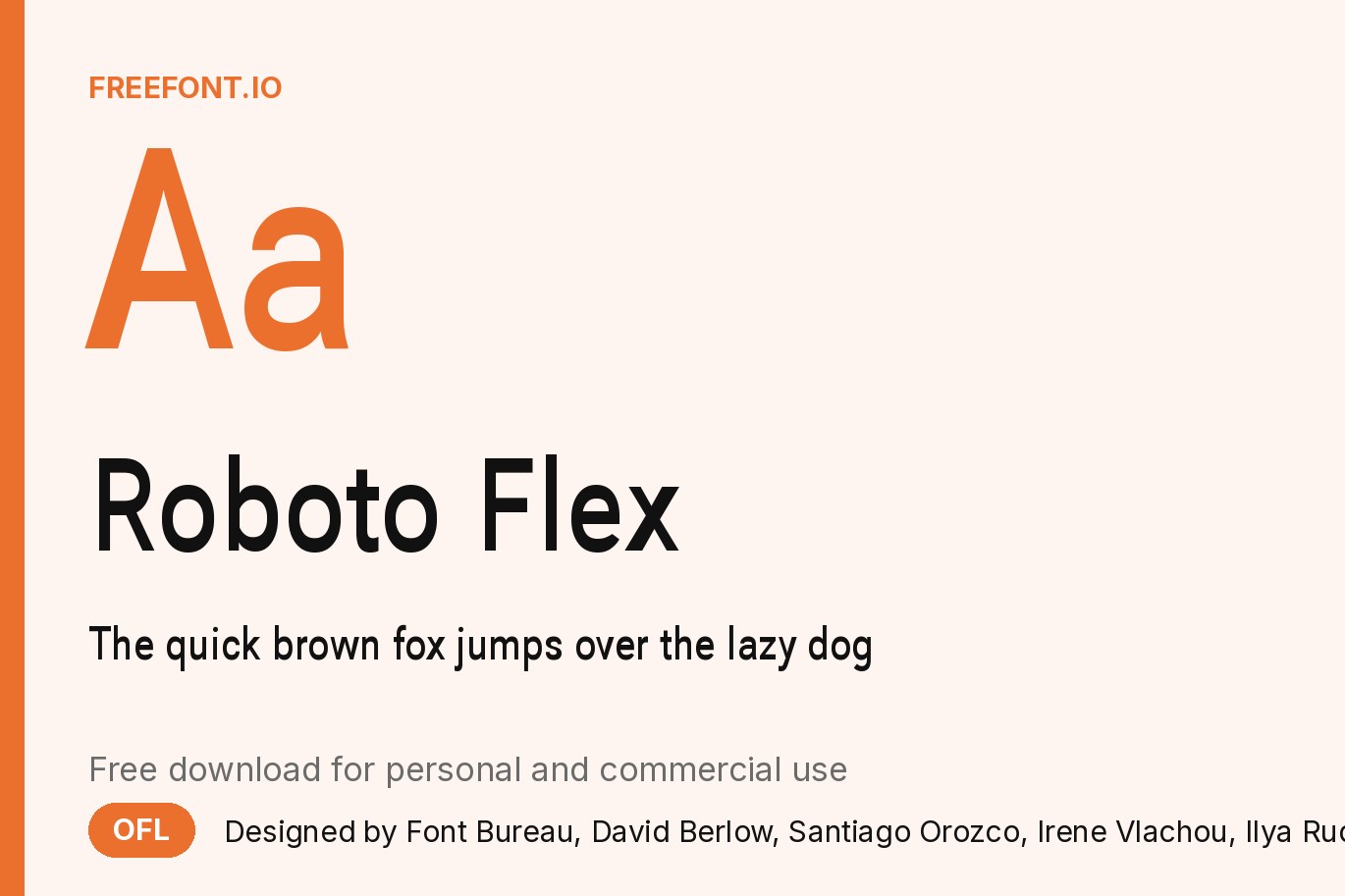
Roboto Flex is a variable upgrade of Roboto, developed by Font Bureau for Google and added to Google Fonts in May 2022. It is based on the design initiated by Christian Robertson. Google asked Font Bureau to reimagine Roboto for a world of shifting devices and large screens, which meant pushing the original design across a very wide range of weights, grades, widths and optical sizes. The named designers on the project include David Berlow, Santiago Orozco, Irene Vlachou, Ilya Ruderman, Yury Ostromentsky and Mikhail Strukov.
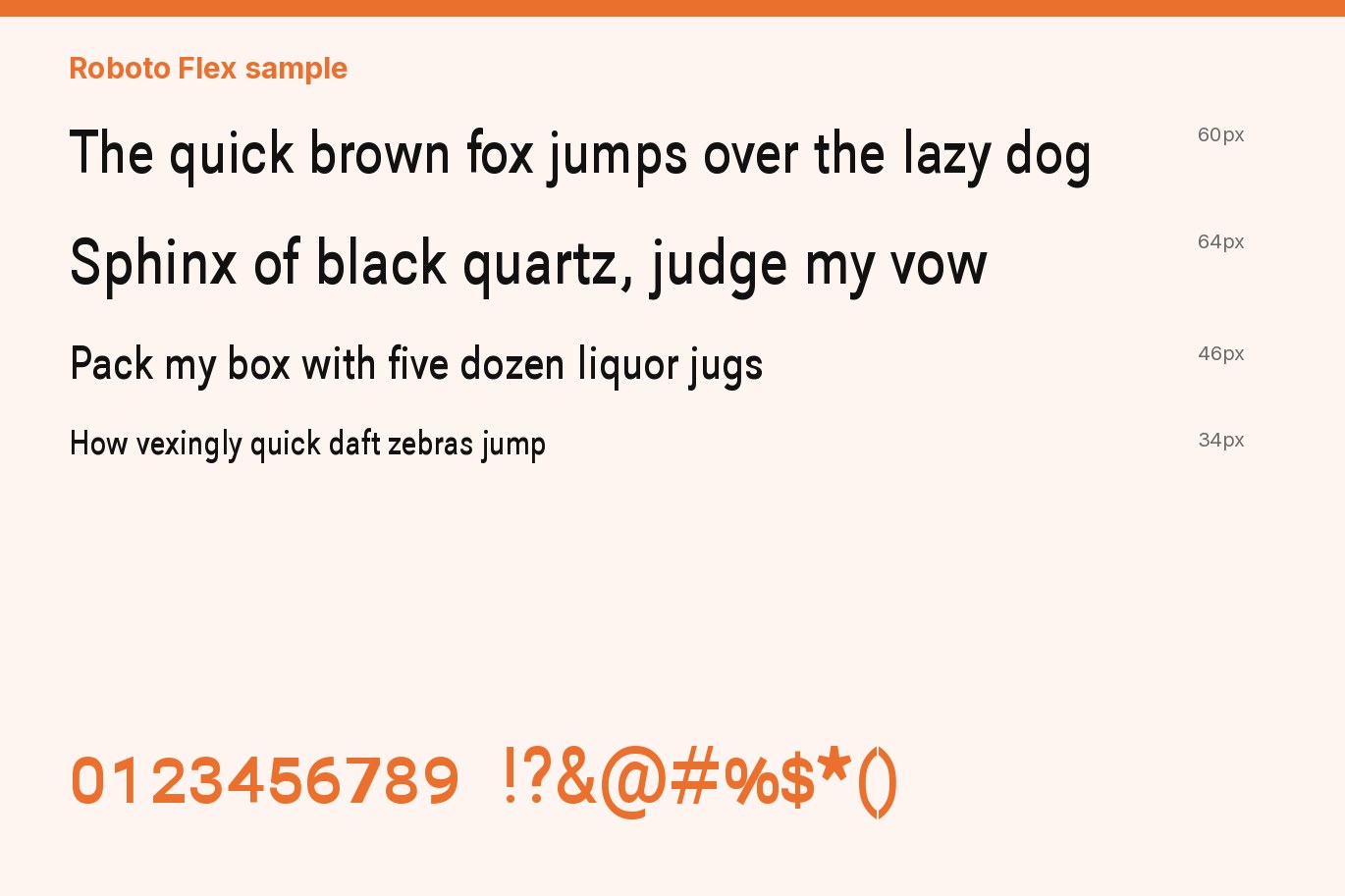
Besides the usual typographic axes, Roboto Flex includes parametric axes so a designer can fine-tune the drawing itself. Weight runs from 100 to 1000, width from 25 to 151, optical size from 8 to 144, slant from -10 to 0, and grade from -200 to 150, with further axes for stroke and contrast details. Font Bureau first showed this parametric approach in Amstelvar Alpha in 2017. The glyph set was expanded with script experts for Cyrillic and Greek. Coverage includes Latin, Latin Extended, Vietnamese, Cyrillic, Cyrillic Extended and Greek. The source is at github.com/googlefonts/roboto-flex.
Best uses for Roboto Flex
- Responsive websites that share one family across sizes
- App interfaces and large-screen layouts
- Dark mode typography using the grade axis
- Headlines and body from a single variable file
- Print and digital work that needs many widths and weights
Font pairings
Roboto Flex can cover many sizes on its own, but a serif still helps long reading. Roboto Slab keeps some of the same skeleton, and Source Serif 4 gives a clearer contrast.
Licence & credit
Roboto Flex is designed by Font Bureau, David Berlow, Santiago Orozco, Irene Vlachou, Ilya Ruderman, Yury Ostromentsky and Mikhail Strukov and released under the SIL Open Font License 1.1. That makes it free for personal and commercial use: logos, packaging, websites, apps, videos and print. You can bundle it in your own projects and modify it. You cannot sell the font files by themselves, and the licence text stays with them. Our guide to the SIL Open Font License explains what that means in practice. The family is also on Google Fonts and its source is on the project page. Released under the SIL Open Font License 1.1, which allows personal and commercial use, embedding and modification. The font files cannot be sold on their own.
Roboto Flex Font Family
License: Personal & Commercial Use
Font Type: Free
Format: TTF
File Size: 1.9 MB
Total Files: 19